AI didn't make our work easier. It made it harder.
AI didn't make our work easier. It made it harder.
Francesca Oddenino
Francesca Oddenino
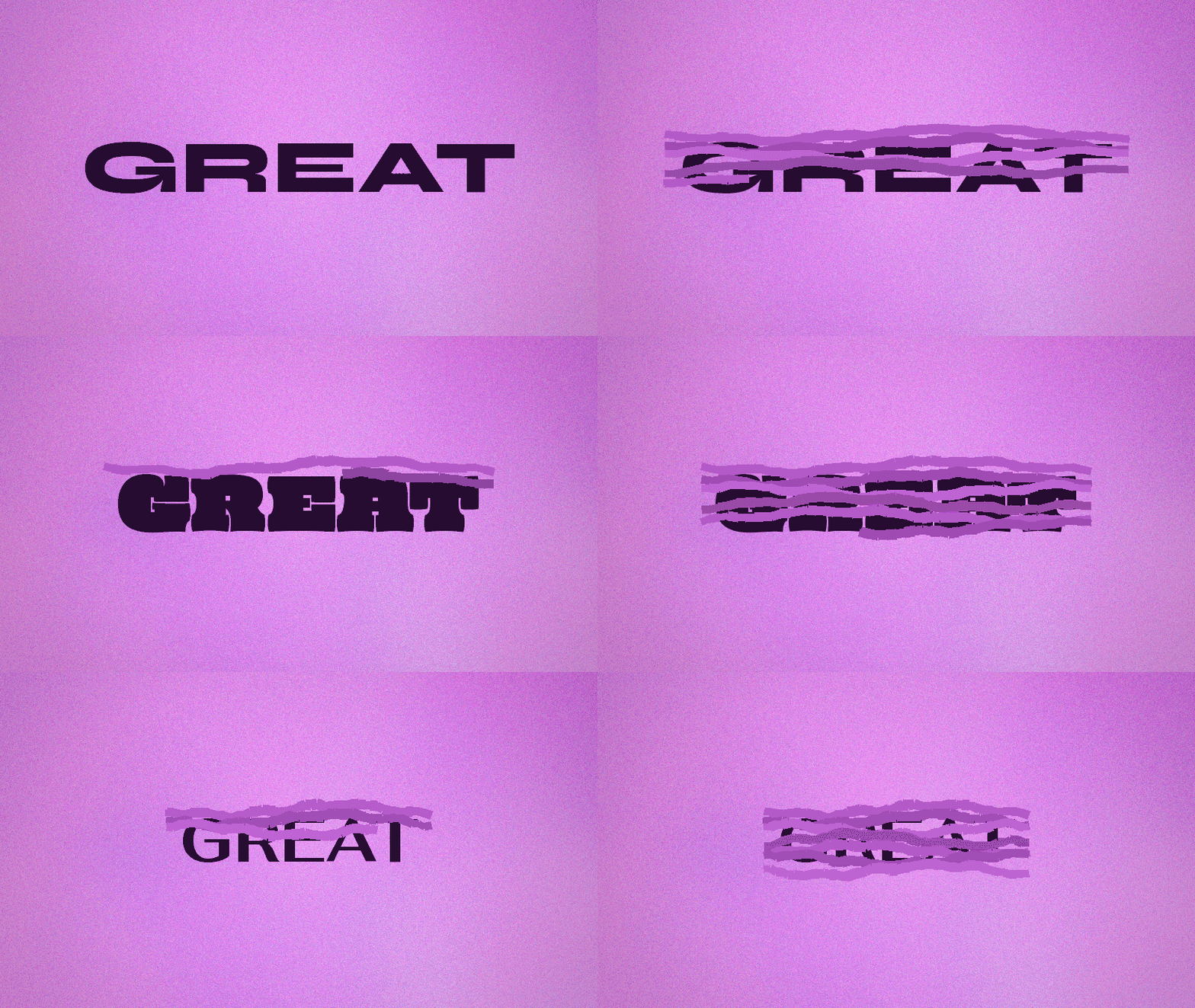
The thing nobody tells you about AI and creative work is that it doesn't make the work easier. It makes it harder. Because now you have no excuse to stop at "good."
Let us explain.
Until fairly recently, the design process looked roughly like this: you start a project, you research, you explore, you iterate, you hit walls, you push through. And eventually, after a significant amount of time and effort, you arrive at a result that's really good. Solid. The client is happy. You feel like you've used your skills well. And you should, because you have.
But here's the thing we’ve been thinking and debating about a lot lately: how many times did you get to a genuinely new place? A place that felt uncomfortable, unfamiliar, where we were genuinely challenging the way we think about design? The reality is that those opportunities don’t come by often, and it’s not because of a lack of ambition. The thing that was always missing was the time to push into creative territory where you don't know if the next version will be better or worse, where the work stops feeling safe and starts feeling like it could actually transform something.
AI changed that. And not in the way most people talk about.
The conversation around AI in design is mostly about speed and efficiency: "we can do things faster now." And sure, that's true. But framing it as a speed story misses what's actually happening. What AI really does is compress the distance to "good." The mechanical parts, the repetitive parts, the parts that don't require critical thinking or taste or human judgment: those get shorter. Sometimes dramatically.
And that compression opens up something we find genuinely exciting: it gives back a ton of time, and with it, it creates space. Real, usable space to stay in a project longer, to keep pushing, to say "no, this isn't there yet" five or six times before saying yes. But also to fail harder, to pursue the weird thought that is most likely going to be wrong, but if it’s right, it could actually create something radically different, innovative even.
And here's what that means in practice. You pour everything into a project, you deliver work you're genuinely proud of, and the client is thrilled. Still, somewhere in the back of your mind, there's a quiet thought: I wonder what this could have been if we'd had more room to explore. It's not that the work wasn't excellent. It was. It's that the structure of how projects work (fixed timelines, fixed budgets, the sheer volume of production work that needs to happen) meant that even the best teams were spending most of their energy getting to a strong result, with very little room left to venture beyond it. Very little room to fail.
AI is changing that structure. The baseline arrives sooner, and instead of wrapping up, there's finally space to sit with the work and ask: what if we pushed this further?
And we don't just mean refining what's already there. We mean taking real creative risks. Exploring directions that could genuinely be a total failure. Going against the grain of what feels safe and expected, and having the time to critique it hard, tear it apart, and figure out if there's something extraordinary hiding inside it. Before, that kind of risk was a luxury most projects couldn't absorb. If you tried something bold and it didn't work, you'd burn time you didn't have. So you stayed within tighter boundaries. Now, there's room to be wrong. Room to try five directions that don't work so you can find the one that really pushes things. That’s liberating, that’s the creative freedom we’ve been starving for.
That freedom is uncomfortable. It's much easier to deliver the version that's polished and professional and earns well-deserved praise. But what excites us is that we're entering an era where "our best given the constraints" can become simply "our best." And that's a different, more ambitious standard.
This is the part that's harder. Pushing past great into something that genuinely stands out requires a different kind of effort. The effort of staying unsatisfied when you could easily stop. Of looking at work that's good and choosing to break it open again. Of getting comfortable with the discomfort of not knowing if the next version will be better or worse.
That's the real creative work. It always was. We just rarely had room for it.
So when people ask us if we’re worried about AI replacing designers, weI tell them the truth: We’re not worried about replacement. We’re worried about the designers who will use AI to get to "great" faster and then stop there. Because the gap between "great" and "extraordinary" just became the only gap that matters. And, in our opinion, closing it has always been, and will always be, a human problem.
The thing nobody tells you about AI and creative work is that it doesn't make the work easier. It makes it harder. Because now you have no excuse to stop at "good."
Let us explain.
Until fairly recently, the design process looked roughly like this: you start a project, you research, you explore, you iterate, you hit walls, you push through. And eventually, after a significant amount of time and effort, you arrive at a result that's really good. Solid. The client is happy. You feel like you've used your skills well. And you should, because you have.
But here's the thing we’ve been thinking and debating about a lot lately: how many times did you get to a genuinely new place? A place that felt uncomfortable, unfamiliar, where we were genuinely challenging the way we think about design? The reality is that those opportunities don’t come by often, and it’s not because of a lack of ambition. The thing that was always missing was the time to push into creative territory where you don't know if the next version will be better or worse, where the work stops feeling safe and starts feeling like it could actually transform something.
AI changed that. And not in the way most people talk about.
The conversation around AI in design is mostly about speed and efficiency: "we can do things faster now." And sure, that's true. But framing it as a speed story misses what's actually happening. What AI really does is compress the distance to "good." The mechanical parts, the repetitive parts, the parts that don't require critical thinking or taste or human judgment: those get shorter. Sometimes dramatically.
And that compression opens up something we find genuinely exciting: it gives back a ton of time, and with it, it creates space. Real, usable space to stay in a project longer, to keep pushing, to say "no, this isn't there yet" five or six times before saying yes. But also to fail harder, to pursue the weird thought that is most likely going to be wrong, but if it’s right, it could actually create something radically different, innovative even.
And here's what that means in practice. You pour everything into a project, you deliver work you're genuinely proud of, and the client is thrilled. Still, somewhere in the back of your mind, there's a quiet thought: I wonder what this could have been if we'd had more room to explore. It's not that the work wasn't excellent. It was. It's that the structure of how projects work (fixed timelines, fixed budgets, the sheer volume of production work that needs to happen) meant that even the best teams were spending most of their energy getting to a strong result, with very little room left to venture beyond it. Very little room to fail.
AI is changing that structure. The baseline arrives sooner, and instead of wrapping up, there's finally space to sit with the work and ask: what if we pushed this further?
And we don't just mean refining what's already there. We mean taking real creative risks. Exploring directions that could genuinely be a total failure. Going against the grain of what feels safe and expected, and having the time to critique it hard, tear it apart, and figure out if there's something extraordinary hiding inside it. Before, that kind of risk was a luxury most projects couldn't absorb. If you tried something bold and it didn't work, you'd burn time you didn't have. So you stayed within tighter boundaries. Now, there's room to be wrong. Room to try five directions that don't work so you can find the one that really pushes things. That’s liberating, that’s the creative freedom we’ve been starving for.
That freedom is uncomfortable. It's much easier to deliver the version that's polished and professional and earns well-deserved praise. But what excites us is that we're entering an era where "our best given the constraints" can become simply "our best." And that's a different, more ambitious standard.
This is the part that's harder. Pushing past great into something that genuinely stands out requires a different kind of effort. The effort of staying unsatisfied when you could easily stop. Of looking at work that's good and choosing to break it open again. Of getting comfortable with the discomfort of not knowing if the next version will be better or worse.
That's the real creative work. It always was. We just rarely had room for it.
So when people ask us if we’re worried about AI replacing designers, weI tell them the truth: We’re not worried about replacement. We’re worried about the designers who will use AI to get to "great" faster and then stop there. Because the gap between "great" and "extraordinary" just became the only gap that matters. And, in our opinion, closing it has always been, and will always be, a human problem.
Related Articles
Related Articles

Hungry for more insights?
Subscribe to our to stay up to date with industry standards.
Let’s talk
Ready to build something remarkable? We partner with ambitious teams who are serious about growth.
Contact Us
© 2026 Vicine
Hungry for more insights?
Subscribe to our to stay up to date with industry standards.
Let’s talk
Ready to build something remarkable? We partner with ambitious teams who are serious about growth.
Contact Us
© 2026 Vicine
Hungry for more insights?
Subscribe to our to stay up to date with industry standards.
Let’s talk
Ready to build something remarkable? We partner with ambitious teams who are serious about growth.
Contact Us
© 2026 Vicine