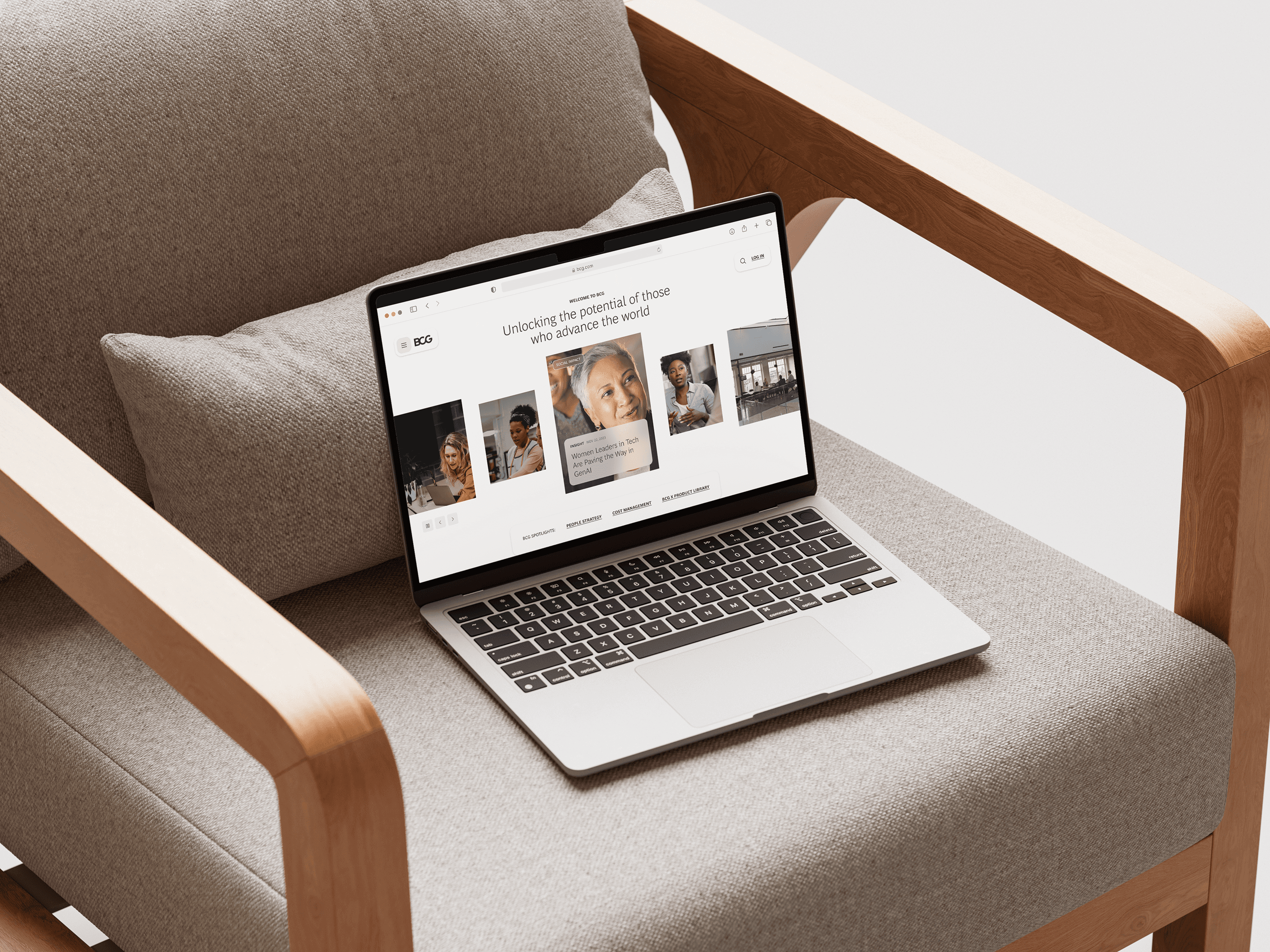
BOSTON CONSULTING GROUP / GLOBAL WEBSITE
BCG — Redesigning a Global Platform, One Layer at a Time
Industry
Consulting
Stage
Enterprise
Services
Brand evolution • Website design • Design systems • UX strategy • Interaction design
How it started
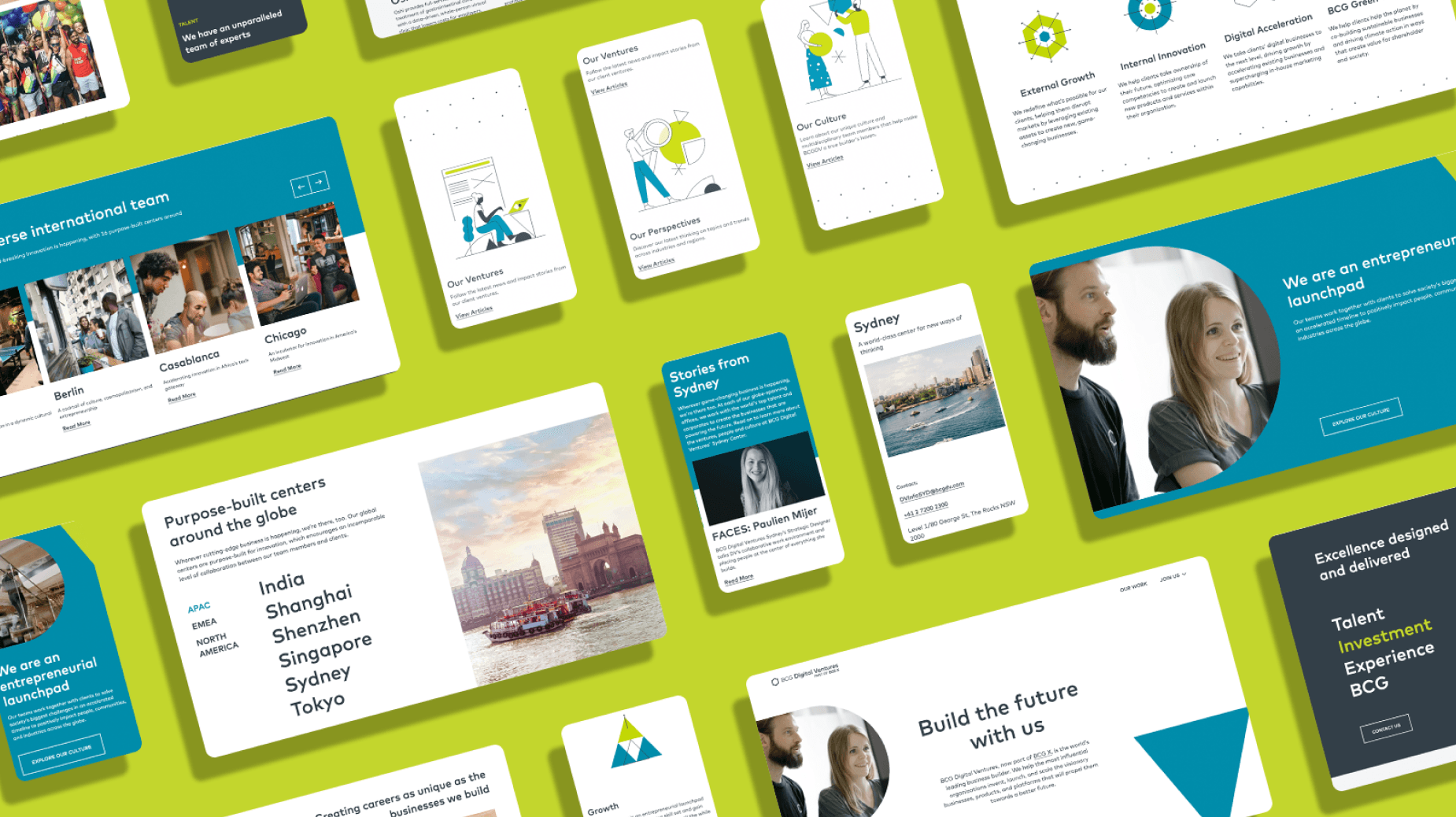
In 2021, BCG Digital Ventures asked us to redesign their global client-facing website. It began with brand identity work — expanding and refining their visual language, building guidelines that could travel across geographies — and evolved into a full site redesign that launched in the summer of 2022.
That project became the foundation for a much longer relationship.
From Digital Ventures to BCG X
When BCG launched BCG X in late 2022 — their tech-build and design unit, absorbing Digital Ventures — we were brought in to design the BCG X presence within BCG.com. This meant translating a new sub-brand into an existing ecosystem: giving BCG X its own personality while keeping it native to the broader site.
Rethinking BCG.com
By 2023, our work had expanded to the platform itself. BCG asked us to lead the redesign of BCG.com — not a reskin, but a structural rethink of how millions of users navigate, discover, and engage with one of the world's most content-rich consulting platforms.
The challenge was layered. BCG.com serves executives, researchers, journalists, job seekers, and internal teams — each with different needs, different journeys, and different expectations. The existing site had accumulated years of legacy patterns, inconsistent layouts, and a navigation system that was creating more confusion than clarity. Our job was to bring order to that complexity without losing the richness underneath.
This work has unfolded across several interconnected workstreams, each solving a different dimension of the problem.
Design system
BCG.com had grown without a unified design system, and it showed — inconsistent layouts, redundant modules, and a fragmented visual language that made the site harder to maintain and harder to use. We built a comprehensive design system from the ground up: a unified grid, a refined typographic and colour palette rooted in BCG's brand identity, and a full library of reusable components following atomic design principles.
One of the more meaningful innovations was a sub-identity system for content types. All cards share the same structural foundation — making them interchangeable across modules — but carry distinct visual cues depending on what they represent. A "Centers" card looks different from a "Product" card, which looks different from a "Publication" card. Users can recognise what they're looking at before they read a word.
Navigation
The existing navigation was a known pain point: ambiguous labels, a confusing dual-menu system (top bar plus hamburger), and deeply nested content that made it hard for users to find what they were looking for. We simplified the structure from nine top-level categories down to four, unified everything under a single menu, and redesigned the interaction model so users could explore industries, capabilities, and sub-topics several layers deep — all without leaving the navigation overlay.
The result is a system that's faster to learn, easier to use, and significantly better at surfacing BCG's depth of content.
Widgets
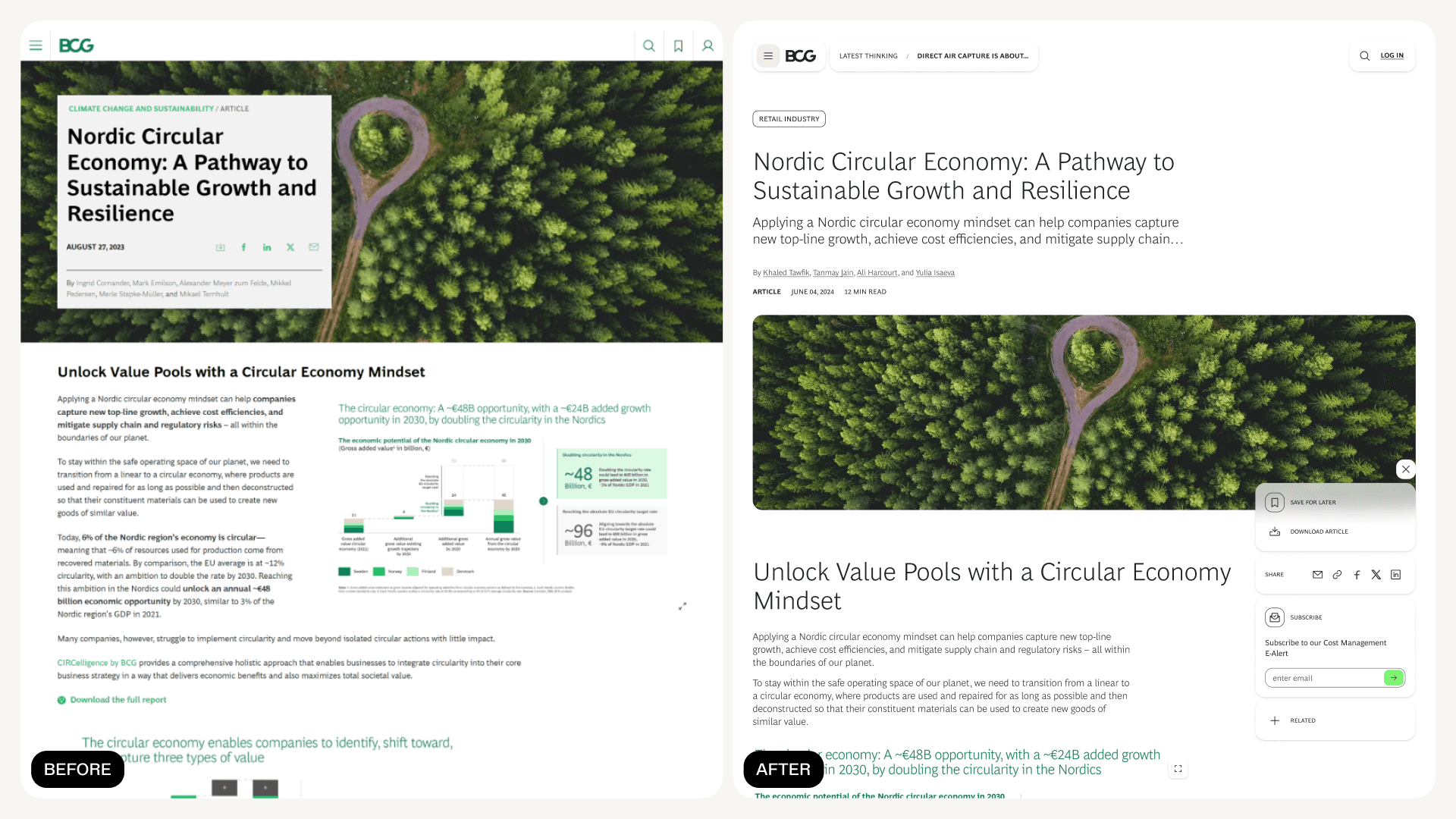
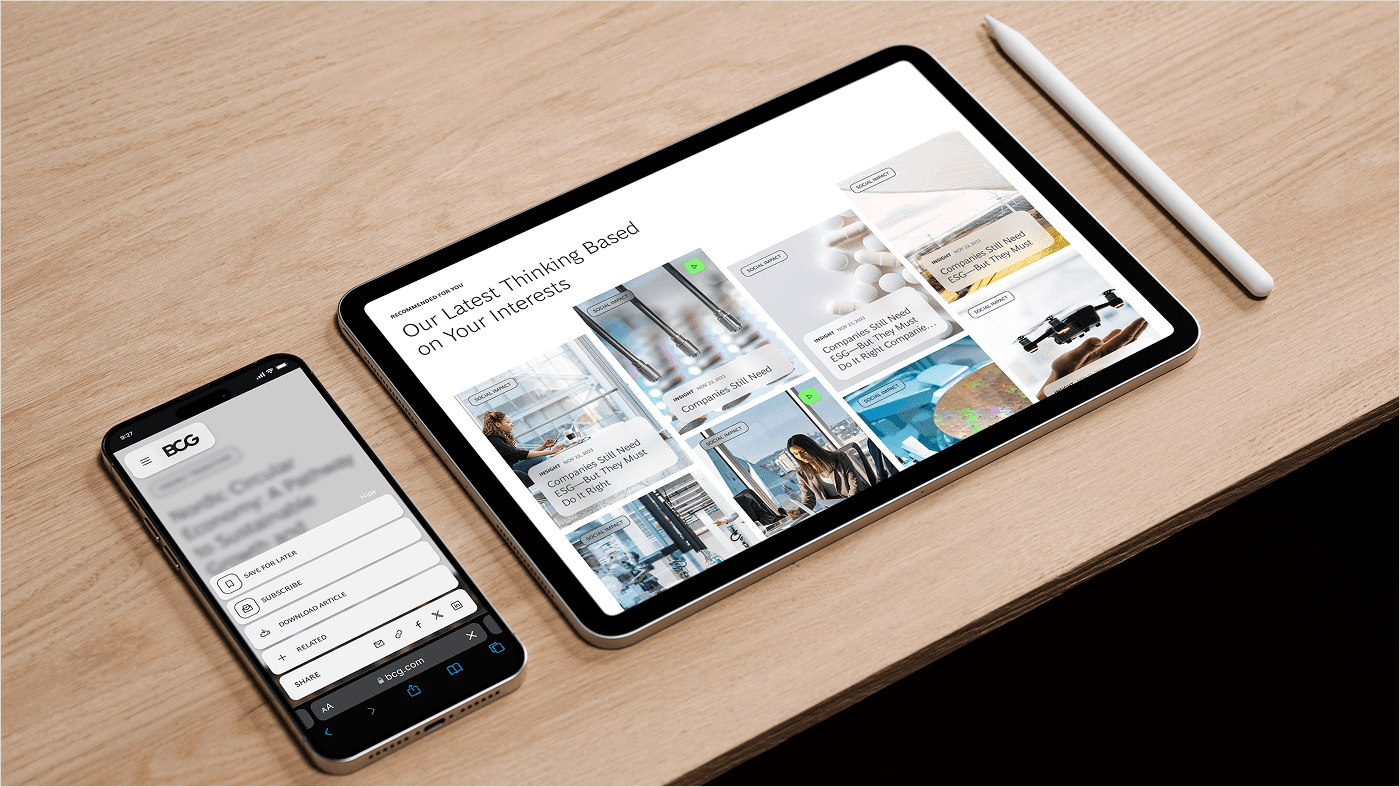
One of the more visible — and commercially impactful — pieces of the redesign was a new interaction layer built on glass-based UI. BCG.com is dense with content: research, publications, executive insights, topic deep-dives. Adding persistent interactive elements to that environment risks making it feel heavier. Glass gave us a way to keep key actions visible and accessible without competing with the content itself.
We consolidated scattered action points — save, download, share, subscribe, contact — into a standardised widget system anchored by a sticky side-rail that follows users as they scroll. The glass treatment makes these elements feel present but not intrusive, layered on top of content without adding visual weight. We also used glass to solve a readability problem: by placing a controlled blur layer between editorial imagery and text on promo cards, we ensured legibility regardless of the background image — giving the content team full creative freedom without manual contrast checking.
Guidelines
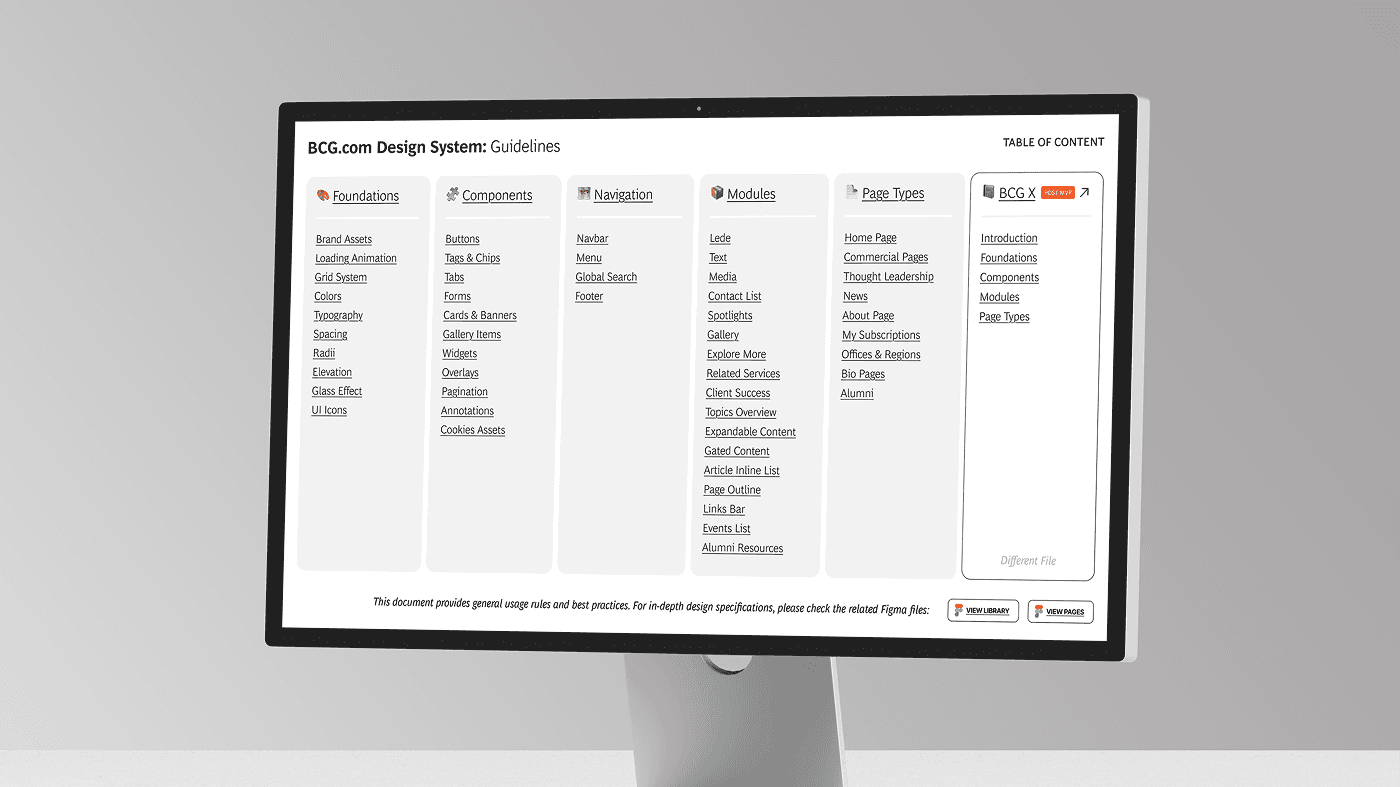
A design system is only as good as the teams using it. BCG.com is maintained by dozens of teams across design, development, content, and branding — and they all needed to work from the same playbook. We built an extensive, self-service guideline system using FigmaSlides, deeply connected to the design library and page templates. It functions as a living document: interlinked, automatically updated, and accessible to anyone with a browser link — no Figma expertise required.
We designed it with the same care we'd give a product. Breadcrumb navigation across 1,000+ pages. Quick-spec cards that surface module specifications on hover. A labelling system to track what's final, what's in progress, and what needs discussion. The goal was always handover: a tool BCG's teams could own and evolve long after our engagement.
AI-powered search
As part of the ongoing evolution of BCG.com, we've most recently been working on an AI-powered search experience — rethinking how users query and discover content across BCG's vast library of thought leadership.
careers
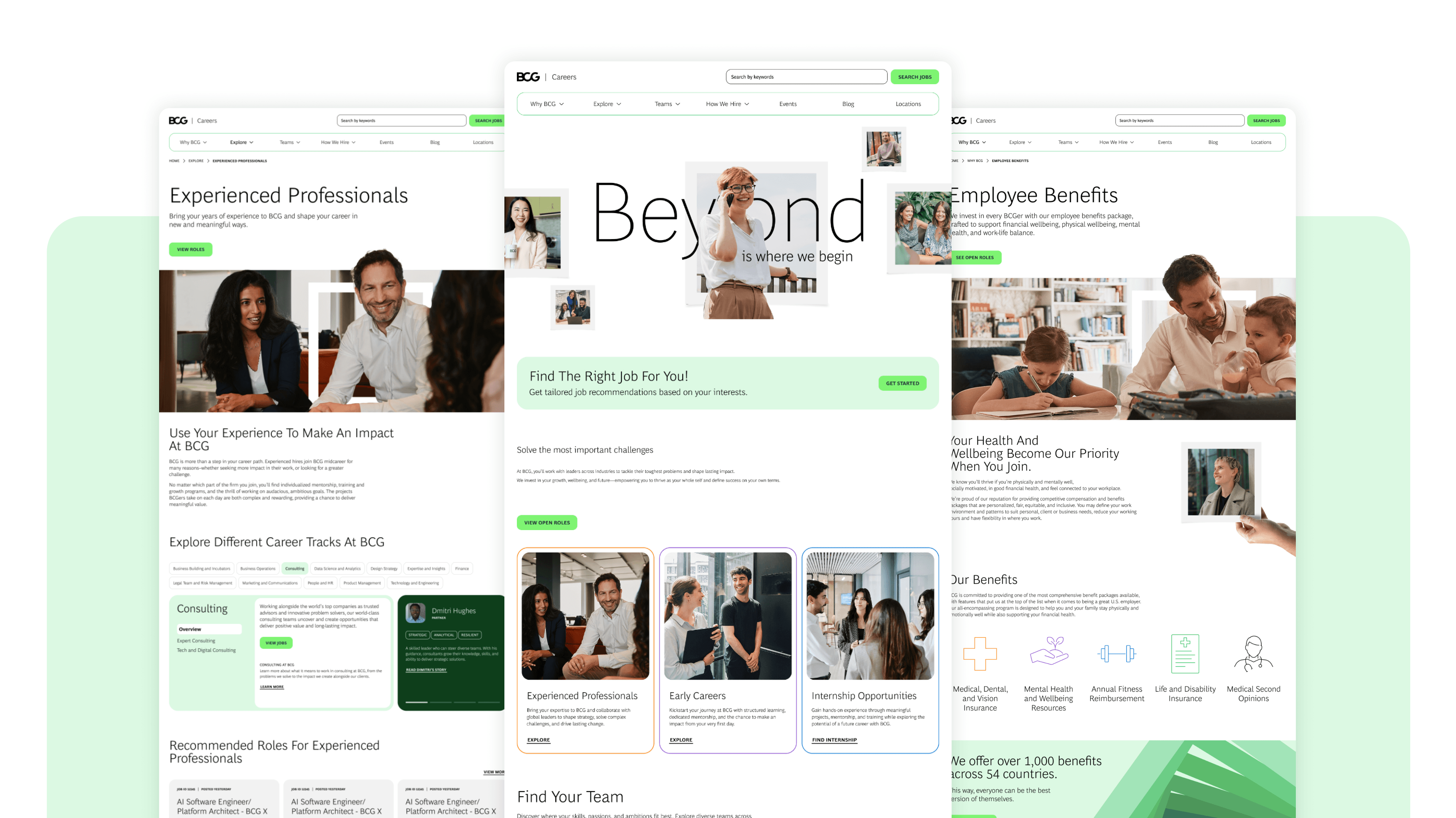
Once the new design system began rolling out across BCG.com, the gap became visible. The Careers experience — living on a separate CMS — was starting to feel disconnected from the rest of the platform. BCG's recruiting team reached out to close that gap: not just visually, but experientially.
The challenge had two sides. On one hand, we needed to bring the careers pages into alignment with the new BCG.com design language so the transition between the two didn't feel like landing on a different site. On the other hand, the Careers experience needed its own tone — one rooted in BCG's recruiting brand campaign, "Beyond is where we begin," and calibrated for a talent audience rather than a consulting audience. The visual system had to flex without breaking.
There was also a meaningful technical constraint. The Careers site runs on Phenom, a specialised recruiting CMS with limited design flexibility compared to the main platform. We had to find ways to elevate the experience within those boundaries — pushing the system as far as it could go while working within what it would actually support.
The impact
This work was never about surface-level polish. Every decision, from navigation structure to glass opacity, was made to help users find what they need, engage with it, and take action. The numbers reflect that.
+28% increase in total site conversions — and importantly, conversions rose significantly more than visits. This wasn't a traffic story. Users on the site were doing more, more often.
Up to +300% increase in contact form submissions across page types, driven by strategically placed CTAs in the footer and bio page side-rails — with some page types seeing uplifts of over 100%.
Meaningful increases in shares, saves, subscriptions, and registrations on publication and topic pages, driven by the persistent visibility of the sticky side-rail system.
Sustained subscription engagement, with article page side-rails and subscription modules remaining visible throughout the reading experience.
No drop in content engagement despite longer pages. Scroll rates held steady even as page height increased — meaning users were consuming more content than before. The added UI elements weren't creating friction. That's the principle behind all of this work: persistent, visible interaction surfaces that don't weigh the experience down.
OnGoing Partnership
We've been working with BCG since 2021. What started as a single website redesign has grown into a multi-year collaboration spanning brand, product, systems, and strategy. New workstreams continue to emerge — each one building on the foundation we've laid together.
We don’t see design as a set of deliverables, but rather as an ongoing conversation. And this partnership is what that looks like.
“I've worked with other design firms where the pitch was promising but the reality was underwhelming. That isn't the case with Vicine. They are enthusiastic, thoughtful collaborators, and their design execution is impressive.”
Michelle Haworth
Senior Director, Global Brand and Creative Strategy, BCG


Hungry for more insights?
Subscribe to our to stay up to date with industry standards.
Let’s talk
Ready to build something remarkable? We partner with ambitious teams who are serious about growth.
Contact Us
© 2026 Vicine
BOSTON CONSULTING GROUP / GLOBAL WEBSITE
BCG — Redesigning a Global Platform, One Layer at a Time
Industry
Consulting
Stage
Enterprise
Services
Brand evolution • Website design • Design systems • UX strategy • Interaction design
How it started
In 2021, BCG Digital Ventures asked us to redesign their global client-facing website. It began with brand identity work — expanding and refining their visual language, building guidelines that could travel across geographies — and evolved into a full site redesign that launched in the summer of 2022.
That project became the foundation for a much longer relationship.
From Digital Ventures to BCG X
When BCG launched BCG X in late 2022 — their tech-build and design unit, absorbing Digital Ventures — we were brought in to design the BCG X presence within BCG.com. This meant translating a new sub-brand into an existing ecosystem: giving BCG X its own personality while keeping it native to the broader site.
Rethinking BCG.com
By 2023, our work had expanded to the platform itself. BCG asked us to lead the redesign of BCG.com — not a reskin, but a structural rethink of how millions of users navigate, discover, and engage with one of the world's most content-rich consulting platforms.
The challenge was layered. BCG.com serves executives, researchers, journalists, job seekers, and internal teams — each with different needs, different journeys, and different expectations. The existing site had accumulated years of legacy patterns, inconsistent layouts, and a navigation system that was creating more confusion than clarity. Our job was to bring order to that complexity without losing the richness underneath.
This work has unfolded across several interconnected workstreams, each solving a different dimension of the problem.
Design system
BCG.com had grown without a unified design system, and it showed — inconsistent layouts, redundant modules, and a fragmented visual language that made the site harder to maintain and harder to use. We built a comprehensive design system from the ground up: a unified grid, a refined typographic and colour palette rooted in BCG's brand identity, and a full library of reusable components following atomic design principles.
One of the more meaningful innovations was a sub-identity system for content types. All cards share the same structural foundation — making them interchangeable across modules — but carry distinct visual cues depending on what they represent. A "Centers" card looks different from a "Product" card, which looks different from a "Publication" card. Users can recognise what they're looking at before they read a word.
Navigation
The existing navigation was a known pain point: ambiguous labels, a confusing dual-menu system (top bar plus hamburger), and deeply nested content that made it hard for users to find what they were looking for. We simplified the structure from nine top-level categories down to four, unified everything under a single menu, and redesigned the interaction model so users could explore industries, capabilities, and sub-topics several layers deep — all without leaving the navigation overlay.
The result is a system that's faster to learn, easier to use, and significantly better at surfacing BCG's depth of content.
Widgets
One of the more visible — and commercially impactful — pieces of the redesign was a new interaction layer built on glass-based UI. BCG.com is dense with content: research, publications, executive insights, topic deep-dives. Adding persistent interactive elements to that environment risks making it feel heavier. Glass gave us a way to keep key actions visible and accessible without competing with the content itself.
We consolidated scattered action points — save, download, share, subscribe, contact — into a standardised widget system anchored by a sticky side-rail that follows users as they scroll. The glass treatment makes these elements feel present but not intrusive, layered on top of content without adding visual weight. We also used glass to solve a readability problem: by placing a controlled blur layer between editorial imagery and text on promo cards, we ensured legibility regardless of the background image — giving the content team full creative freedom without manual contrast checking.
Guidelines
A design system is only as good as the teams using it. BCG.com is maintained by dozens of teams across design, development, content, and branding — and they all needed to work from the same playbook. We built an extensive, self-service guideline system using FigmaSlides, deeply connected to the design library and page templates. It functions as a living document: interlinked, automatically updated, and accessible to anyone with a browser link — no Figma expertise required.
We designed it with the same care we'd give a product. Breadcrumb navigation across 1,000+ pages. Quick-spec cards that surface module specifications on hover. A labelling system to track what's final, what's in progress, and what needs discussion. The goal was always handover: a tool BCG's teams could own and evolve long after our engagement.
AI-powered search
As part of the ongoing evolution of BCG.com, we've most recently been working on an AI-powered search experience — rethinking how users query and discover content across BCG's vast library of thought leadership.
careers
Once the new design system began rolling out across BCG.com, the gap became visible. The Careers experience — living on a separate CMS — was starting to feel disconnected from the rest of the platform. BCG's recruiting team reached out to close that gap: not just visually, but experientially.
The challenge had two sides. On one hand, we needed to bring the careers pages into alignment with the new BCG.com design language so the transition between the two didn't feel like landing on a different site. On the other hand, the Careers experience needed its own tone — one rooted in BCG's recruiting brand campaign, "Beyond is where we begin," and calibrated for a talent audience rather than a consulting audience. The visual system had to flex without breaking.
There was also a meaningful technical constraint. The Careers site runs on Phenom, a specialised recruiting CMS with limited design flexibility compared to the main platform. We had to find ways to elevate the experience within those boundaries — pushing the system as far as it could go while working within what it would actually support.
The impact
This work was never about surface-level polish. Every decision, from navigation structure to glass opacity, was made to help users find what they need, engage with it, and take action. The numbers reflect that.
+28% increase in total site conversions — and importantly, conversions rose significantly more than visits. This wasn't a traffic story. Users on the site were doing more, more often.
Up to +300% increase in contact form submissions across page types, driven by strategically placed CTAs in the footer and bio page side-rails — with some page types seeing uplifts of over 100%.
Meaningful increases in shares, saves, subscriptions, and registrations on publication and topic pages, driven by the persistent visibility of the sticky side-rail system.
Sustained subscription engagement, with article page side-rails and subscription modules remaining visible throughout the reading experience.
No drop in content engagement despite longer pages. Scroll rates held steady even as page height increased — meaning users were consuming more content than before. The added UI elements weren't creating friction. That's the principle behind all of this work: persistent, visible interaction surfaces that don't weigh the experience down.
OnGoing Partnership
We've been working with BCG since 2021. What started as a single website redesign has grown into a multi-year collaboration spanning brand, product, systems, and strategy. New workstreams continue to emerge — each one building on the foundation we've laid together.
We don’t see design as a set of deliverables, but rather as an ongoing conversation. And this partnership is what that looks like.
“I've worked with other design firms where the pitch was promising but the reality was underwhelming. That isn't the case with Vicine. They are enthusiastic, thoughtful collaborators, and their design execution is impressive.”
Michelle Haworth
Senior Director, Global Brand and Creative Strategy, BCG
Hungry for more insights?
Subscribe to our to stay up to date with industry standards.
Let’s talk
Ready to build something remarkable? We partner with ambitious teams who are serious about growth.
Contact Us
© 2026 Vicine
BOSTON CONSULTING GROUP / GLOBAL WEBSITE
BCG — Redesigning a Global Platform, One Layer at a Time
INDUSTRY
Consulting
STAGE
Enterprise
SERVICES
Brand evolution • Website design • Design systems • UX strategy • Interaction design
How it started
In 2021, BCG Digital Ventures asked us to redesign their global client-facing website. It began with brand identity work — expanding and refining their visual language, building guidelines that could travel across geographies — and evolved into a full site redesign that launched in the summer of 2022.
That project became the foundation for a much longer relationship.
From Digital Ventures to BCG X
When BCG launched BCG X in late 2022 — their tech-build and design unit, absorbing Digital Ventures — we were brought in to design the BCG X presence within BCG.com. This meant translating a new sub-brand into an existing ecosystem: giving BCG X its own personality while keeping it native to the broader site.
Rethinking BCG.com
By 2023, our work had expanded to the platform itself. BCG asked us to lead the redesign of BCG.com — not a reskin, but a structural rethink of how millions of users navigate, discover, and engage with one of the world's most content-rich consulting platforms.
The challenge was layered. BCG.com serves executives, researchers, journalists, job seekers, and internal teams — each with different needs, different journeys, and different expectations. The existing site had accumulated years of legacy patterns, inconsistent layouts, and a navigation system that was creating more confusion than clarity. Our job was to bring order to that complexity without losing the richness underneath.
This work has unfolded across several interconnected workstreams, each solving a different dimension of the problem.
Design system
BCG.com had grown without a unified design system, and it showed — inconsistent layouts, redundant modules, and a fragmented visual language that made the site harder to maintain and harder to use. We built a comprehensive design system from the ground up: a unified grid, a refined typographic and colour palette rooted in BCG's brand identity, and a full library of reusable components following atomic design principles.
One of the more meaningful innovations was a sub-identity system for content types. All cards share the same structural foundation — making them interchangeable across modules — but carry distinct visual cues depending on what they represent. A "Centers" card looks different from a "Product" card, which looks different from a "Publication" card. Users can recognise what they're looking at before they read a word.
Navigation
The existing navigation was a known pain point: ambiguous labels, a confusing dual-menu system (top bar plus hamburger), and deeply nested content that made it hard for users to find what they were looking for. We simplified the structure from nine top-level categories down to four, unified everything under a single menu, and redesigned the interaction model so users could explore industries, capabilities, and sub-topics several layers deep — all without leaving the navigation overlay.
The result is a system that's faster to learn, easier to use, and significantly better at surfacing BCG's depth of content.
Widgets
One of the more visible — and commercially impactful — pieces of the redesign was a new interaction layer built on glass-based UI. BCG.com is dense with content: research, publications, executive insights, topic deep-dives. Adding persistent interactive elements to that environment risks making it feel heavier. Glass gave us a way to keep key actions visible and accessible without competing with the content itself.
We consolidated scattered action points — save, download, share, subscribe, contact — into a standardised widget system anchored by a sticky side-rail that follows users as they scroll. The glass treatment makes these elements feel present but not intrusive, layered on top of content without adding visual weight. We also used glass to solve a readability problem: by placing a controlled blur layer between editorial imagery and text on promo cards, we ensured legibility regardless of the background image — giving the content team full creative freedom without manual contrast checking.
Guidelines
A design system is only as good as the teams using it. BCG.com is maintained by dozens of teams across design, development, content, and branding — and they all needed to work from the same playbook. We built an extensive, self-service guideline system using FigmaSlides, deeply connected to the design library and page templates. It functions as a living document: interlinked, automatically updated, and accessible to anyone with a browser link — no Figma expertise required.
We designed it with the same care we'd give a product. Breadcrumb navigation across 1,000+ pages. Quick-spec cards that surface module specifications on hover. A labelling system to track what's final, what's in progress, and what needs discussion. The goal was always handover: a tool BCG's teams could own and evolve long after our engagement.
AI-powered search
As part of the ongoing evolution of BCG.com, we've most recently been working on an AI-powered search experience — rethinking how users query and discover content across BCG's vast library of thought leadership.
careers
Once the new design system began rolling out across BCG.com, the gap became visible. The Careers experience — living on a separate CMS — was starting to feel disconnected from the rest of the platform. BCG's recruiting team reached out to close that gap: not just visually, but experientially.
The challenge had two sides. On one hand, we needed to bring the careers pages into alignment with the new BCG.com design language so the transition between the two didn't feel like landing on a different site. On the other hand, the Careers experience needed its own tone — one rooted in BCG's recruiting brand campaign, "Beyond is where we begin," and calibrated for a talent audience rather than a consulting audience. The visual system had to flex without breaking.
There was also a meaningful technical constraint. The Careers site runs on Phenom, a specialised recruiting CMS with limited design flexibility compared to the main platform. We had to find ways to elevate the experience within those boundaries — pushing the system as far as it could go while working within what it would actually support.
The impact
This work was never about surface-level polish. Every decision, from navigation structure to glass opacity, was made to help users find what they need, engage with it, and take action. The numbers reflect that.
+28% increase in total site conversions — and importantly, conversions rose significantly more than visits. This wasn't a traffic story. Users on the site were doing more, more often.
Up to +300% increase in contact form submissions across page types, driven by strategically placed CTAs in the footer and bio page side-rails — with some page types seeing uplifts of over 100%.
Meaningful increases in shares, saves, subscriptions, and registrations on publication and topic pages, driven by the persistent visibility of the sticky side-rail system.
Sustained subscription engagement, with article page side-rails and subscription modules remaining visible throughout the reading experience.
No drop in content engagement despite longer pages. Scroll rates held steady even as page height increased — meaning users were consuming more content than before. The added UI elements weren't creating friction. That's the principle behind all of this work: persistent, visible interaction surfaces that don't weigh the experience down.
OnGoing Partnership
We've been working with BCG since 2021. What started as a single website redesign has grown into a multi-year collaboration spanning brand, product, systems, and strategy. New workstreams continue to emerge — each one building on the foundation we've laid together.
We don’t see design as a set of deliverables, but rather as an ongoing conversation. And this partnership is what that looks like.
“I've worked with other design firms where the pitch was promising but the reality was underwhelming. That isn't the case with Vicine. They are enthusiastic, thoughtful collaborators, and their design execution is impressive.”
Michelle Haworth
Senior Director, Global Brand and Creative Strategy, BCG


Hungry for more insights?
Subscribe to our to stay up to date with industry standards.
Let’s talk
Ready to build something remarkable? We partner with ambitious teams who are serious about growth.
Contact Us
© 2026 Vicine